The Roundtable
Welcome to the Roundtable, a forum for incisive commentary and analysis
on cases and developments in law and the legal system.
on cases and developments in law and the legal system.

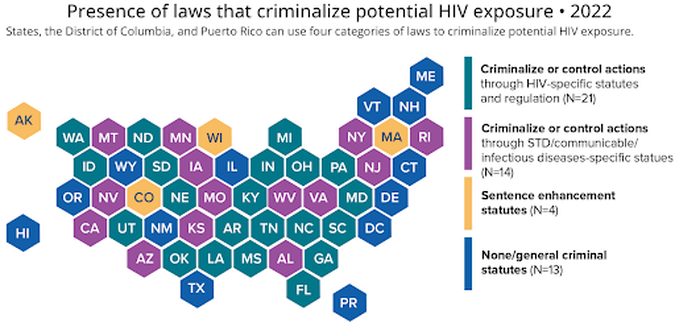 By Catherine Tang Catherine Tang is a freshman at the University of Pennsylvania majoring in Health and Societies with a concentration in Health Policy & Law. In 2008, a black man from Louisiana was charged with a felony for intentionally exposing his partner to AIDS despite not having it. Instead, the man was diagnosed with HIV and has been receiving consistent medical care since. [1] In 2010, an HIV-positive protester in Maryland was given five years in prison for second-degree assault because he spit on a police officer. [2] From 2008 to 2013, at least 180 people living with HIV (PLHIV) have been arrested or charged under HIV criminalization laws. [3] During the early years of the epidemic, public fear and a widespread stigma against HIV incited a global rush to prosecute HIV-positive individuals. The U.S. became the first country to introduce HIV-specific criminal laws in 1987, establishing penalties for “failing to disclose infection, for exposing others to the disease, and for transmitting the disease intentionally or unintentionally.” [4] The passage of the Ryan White Comprehensive AIDS Resources Emergency (CARE) Act in 1990 required all states to certify that they had a legal mechanism in place to prosecute HIV-infected individuals who knowingly exposed others to HIV, and currently, 33 states and two U.S. territories have varying degrees of HIV criminalization laws. [5]
On the surface, laws requiring the disclosure of HIV status before participating in activities that increase transmission risk may seem like a good idea. However, a 2017 study revealed that in the 30 states that had HIV criminalization statutes, there was no correlation between the laws and HIV diagnoses. [6] Furthermore, the majority of such laws were passed before medication mitigating or preventing HIV was even developed. For example, antiretroviral therapy (ART) can virally suppress HIV and stop individuals from transmitting HIV to others. Pre-exposure prophylaxis (PrEP) can reduce the risk of HIV by 99%. [7] However, HIV criminalization laws continue to apply, despite protective measures PLHIV may take. Yet, HIV-specific laws are not applied to other sexually transmitted diseases such as Hepatitis C and B. [8] As a result, laws often impose criminal liability solely on the basis that the defendant was HIV-positive, meaning some were prosecuted despite a lack of actual transmission or in cases where the risk of transmission was very low. For instance, 14 states criminalize biting, spitting, or oral sex by HIV-positive persons, yet saliva is not a scientifically proven transmission risk. [9] Widespread ignorance and stigma have also caused PLHIV’s blood, semen, and saliva to be referred to as “deadly weapons,” meaning they could be charged with aggravated assault, attempted murder, and even bioterrorism. [10] Consequently, HIV exposure laws could very well backfire. For example, fear of criminalization could dissuade PLHIV from discussing their sexual behavior with doctors because doctors’ notes could later be subpoenaed, and the laws could also prompt people at risk not to get tested because their HIV status would make them legally culpable. [11] In other words, someone who is HIV-positive but does not know their status cannot be prosecuted. Yet, if someone decides to get tested and finds out that they are HIV-positive, they can then be prosecuted. HIV criminalization laws also disproportionately impact historically marginalized groups, including people of color, sex workers, and men who have sex with other men (MSM). [12] A disease of poverty and stigma, HIV is especially prevalent in under-resourced neighborhoods that face a variety of barriers to HIV care and prevention. Chief among them is housing instability, with PLHIV making up 3.3% of the homeless population in 2010, and the rates of HIV infection are up to 16 times higher among those who experience homelessness. [13] Furthermore, racial minorities who reside in less affluent neighborhoods have more interactions with the police, making them more susceptible to becoming targets of HIV-related crimes. In fact, black men are twice as likely to be convicted of HIV-related crimes than white men. [14] Sex workers are also another group that is disproportionately harmed. For instance, among the 800 cases of prosecutions under HIV-related laws in California between 1998 and 2014, 95% involved sex workers or people accused of sex work. [15] Compounding excessive criminalization, many PLHIV are unaware that such laws even exist. A 2017 study revealed that across 16 states, 75% of MSM, whether HIV-positive or not, were unaware of their state laws, making them even more vulnerable to incarceration. [16] Ultimately, HIV laws do more harm than good and disproportionately target vulnerable populations who are at the most risk for HIV yet have limited prevention and treatment options. Currently, there are no federal laws explicitly addressing HIV criminalization, although several laws have been introduced but failed in committee. One of them is the Repeal Existing Policies that Encourage and Allow Legal (REPEAL) HIV Discrimination Act, which was introduced in 2013 by Congresswoman Barbara Lee (D-CA 12th District). While a number of its recommendations have been adopted by numerous state and federal agencies and initiatives, such as the National AIDS Strategy, the CDC, the DOJ, and the Uniform Code of Military Justice (UCMJ), it has yet to achieve congressional approval from the House or Senate. [17] Recent years have seen pushback from activists and legislators to repeal or modernize outdated HIV criminalization laws at the state level. Texas became the first state to repeal its criminalization statutes in 1994, yet PLHIV can still be prosecuted under general criminal laws and face charges such as attempted murder and aggravated assault. [18] In July 2021, Illinois’ House Bill 1063 repealed the Illinois Criminal Transmission of HIV statute, which eliminated the threat of prosecution and incarceration for PLHIV and instead treated HIV as any other long-term chronic disease. [19] Furthermore, 11 states, including California, Michigan, Missouri, Nevada, and North Carolina, have modernized their laws. [20] Enacted measures include requiring intent to transmit, taking into account PLHIV who took practical measures to prevent HIV transmission such as ART and condom use, reducing criminalization penalties from a felony to a misdemeanor, and removing the provision from the criminal code to be part of the administrative code as a measure to help control communicable diseases. It is important to note, however, that there are reasons to remain cautious despite significant progress. For instance, modernized laws preventing prosecution of PLHIV who are virally suppressed may exclude groups, such as sex workers, who are already less likely to access the services they need to achieve “undetectable” viral load status. In conclusion, HIV criminalization cannot be solved by a silver bullet solution but rather demands a multifaceted re-examination and redefinition of legislative and societal structures. Laws should be written intending to not only prevent transmission but also to protect PLHIV, and medical advancements necessitate legal modernization as new therapies and treatments increasingly reduce transmission risk. Ultimately, PLHIV should not be prosecuted simply because the law cannot keep pace with science. [1] “Truthout: People With HIV Are Still Being Criminalized in 25 States.” The Center for HIV Law and Policy, January 26, 2023. www.hivlawandpolicy.org/news/truthout-people-hiv-are-still-being-criminalized-25-states. [2] Satta, Mark. “Spitting at Science: The Unjustified Criminalization of Spitting While HIV-Positive.” Bill of Health, February 25, 2019. blog.petrieflom.law.harvard.edu/2019/02/25/spitting-at-science-the-unjustified-criminalization-of-spitting-while-hiv-positive/#:~:text=And%20in%202016%20in%20Texas,answer%20to%20that%20is%20complex. [3] “HIV Criminalization in the United States: A Sourcebook on State and Federal HIV Criminal Law and Practice, CHLP (updated February 2022).” The Center for HIV Law and Policy. www.hivlawandpolicy.org/resources/hiv-criminalization-united-states-sourcebook-state-and-federal-hiv-criminal-law-and. [4] Ibid. [5] Harsono, Dini et al. “Criminalization of HIV Exposure: A Review of Empirical Studies in the United States.” AIDS and Behavior, September 7, 2016. https://link.springer.com/article/10.1007/s10461-016-1540-5. [6] Sweeney, Patricia et al. “Association of HIV diagnosis rates and laws criminalizing HIV exposure in the United States.” AIDS, June 19, 2017. https://journals.lww.com/aidsonline/fulltext/2017/06190/association_of_hiv_diagnosis_rates_and_laws.15.aspx. [7] “HIV Treatment as Prevention.” Centers for Disease Control and Prevention. https://www.cdc.gov/hiv/risk/art/index.html. [8] “HIV Criminalization.” American Academy of Medicine. https://aahivm.org/hiv-criminalization/#:~:text=Early%20in%20the%20history%20of,the%20disease%20intentionally%20or%20unintentionally. [9] “HIV Basics.” Centers for Disease Control and Prevention. https://www.cdc.gov/hiv/basics/hiv-transmission/ways-people-get-hiv.html#:~:text=Very%20rarely%2C%20transmission%20has%20occurred,t%20transmit%20HIV%20through%20saliva. [10] “HIV Criminalization in the United States: A Sourcebook on State and Federal HIV Criminal Law and Practice, CHLP (updated February 2022).” The Center for HIV Law and Policy. www.hivlawandpolicy.org/resources/hiv-criminalization-united-states-sourcebook-state-and-federal-hiv-criminal-law-and. [11] Pappas, Stephanie. “HIV Laws that Appear to Do More Harm than Good.” American Psychological Association, October 2018. www.apa.org/monitor/2018/10/ce-corner. [12] “HIV Statistics: Impact on Racial and Ethnic Minorities.” HIV.gov. https://www.hiv.gov/hiv-basics/overview/data-and-trends/impact-on-racial-and-ethnic-minorities/. [13] Thakarar, Kinna. “Homelessness, HIV, and Incomplete Viral Suppression.” Journal of Health Care for the Poor and Underserved, February 2016. www.ncbi.nlm.nih.gov/pmc/articles/PMC4982659/. [14] Bernard, Edward et al. “Punishing Vulnerability Through HIV Criminalization.” American Public Health Association, June 28, 2022. www.ncbi.nlm.nih.gov/pmc/articles/PMC9241463/#:~:text=Newcomers%20and%20racial%20minorities%20often,racism%20manifesting%20in%20HIV%20criminalization. [15] Amira, Hasenbush et al. “HIV Criminalization in California: Penal Implications for People Living with HIV/AIDS.” The Williams Institute, December 2015. https://williamsinstitute.law.ucla.edu/wp-content/uploads/HIV-Criminalization-CA-Dec-2015.pdf. [16] Horvath, Keith et al. “Men Who Have Sex with Men Who Believe that Their State has a HIV Criminal Law Report Higher Condomless Anal Sex than Those Who are Unsure of the Law in Their State.” AIDS and Behavior, January 16, 2016. https://link.springer.com/article/10.1007/s10461-016-1286-0. [17] “REPEAL Act.” The Center for HIV Law and Policy. www.hivlawandpolicy.org/sites/default/files/REPEAL%20ACT%202022%20Fact%20Sheet%2C%20Rep.%20Barbara%20Lee%20%282022%29.pdf. [18] “Texas.” The Center for HIV Law and Policy. www.hivlawandpolicy.org/state-profiles/texas#:~:text=In%201994%2C%20Texas%20became%20the,%2C%20Before%20and%20After%3A%20Texas. [19] “Decriminalization of HIV in Illinois Happened Due to Collaboration Across the State.” Illinois HIV Care Connect. https://hivcareconnect.com/decriminalization-of-hiv-in-illinois-happened-due-to-collaboration-across-the-state/#:~:text=Only%20two%20U.S.%20states%20have,law%20on%20July%2027%2C%202021. [20] “HIV and STD Criminalization Laws.” Centers for Disease Control and Prevention. https://www.cdc.gov/hiv/policies/law/states/exposure.html. The opinions and views expressed in this publication are the opinions of the designated authors and do not reflect the opinions or views of the Penn Undergraduate Law Journal, our staff, or our clients.
0 Comments
Your comment will be posted after it is approved.
Leave a Reply. |

|

|