The Roundtable
Welcome to the Roundtable, a forum for incisive commentary and analysis
on cases and developments in law and the legal system.
on cases and developments in law and the legal system.

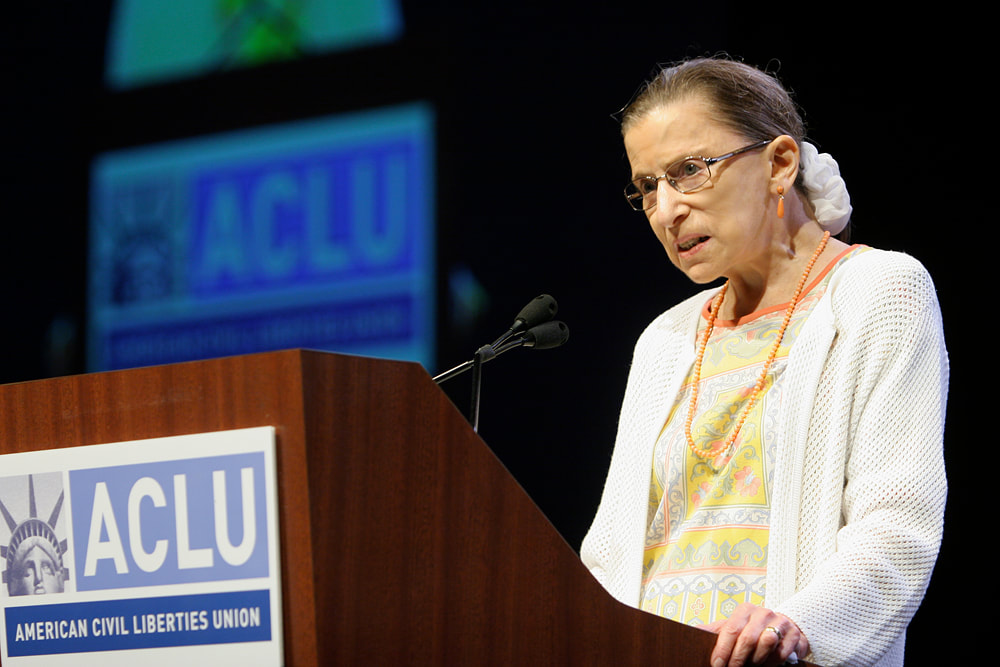 By Kaitlyn Rentala Kaitlyn Rentala is a sophomore in the College of Arts and Sciences at the University of Pennsylvania studying Philosophy, Politics, and Economics. At 86, Supreme Court Justice Ruth Bader Ginsburg is the oldest member of the bench, but still one of the most impactful. Throughout her long lasting career, Ginsburg has distinguished herself as a leader in the women’s rights movement all while overcoming personal struggles and misogyny. This year celebrates her 26th year anniversary on the bench. Here is a look back at Ruth Bader Ginsburg’s influence over US law and culture. Ruth Bader Ginsburg was born on March 15, 1933 in Brooklyn, New York. Growing up, Ginsburg excelled at school, largely due to her supportive mother who instilled in her a love of learning. Unfortunately, her mother was diagnosed with cancer and passed away the day before Ginsburg’s high school graduation. Ginsburg succeeded throughout her undergraduate years at Cornell University, where she also met her husband Martin. In 1954, Ginsburg graduated Cornell top of her class and in the same year, married Martin. After a two year gap, Ginsburg enrolled in Harvard Law School, one of just nine women in her 500 person class. At Harvard, Ginsburg faced significant personal challenges when her husband was diagnosed with testicular cancer. Ginsburg not only managed to keep her sick husband up to date with his own studies, but also managed to keep her own status at the top of her class and was the first woman named to the Harvard Law Review. When her husband recovered from cancer and accepted a job at a New York law firm, Ginsburg followed, transferring to Columbia Law School and graduating first in her class [1]. Ginsburg’s path to success was filled with sexism and discrimination. While at Harvard Law School, the dean of Harvard Law asked every female student to explain why they were taking a spot away from a man. Despite graduating first in her class at Columbia Law, no firm in New York would offer her a job due to gender discrimination. Finally, Ginsburg took a clerking position with US District Judge Edmund L. Palmieri after a Columbia professor refused to recommend any other clerks until Palmieri took on Ginsburg [1]. After two years, Ginsburg had a few offers from some New York law firms, but at a much lower salary than her male counterparts. Instead of accepting a lower salary, Ginsburg decided to join the Columbia Project on International Civil Procedure. Later on, she became the first female tenured professor at Columbia Law School [2]. In the 1970s, Ginsburg directed the newly founded ACLU Women’s Rights Project, whose primary mission was to advocate for gender equality in the eyes of the law [2]. In total, Ginsburg argued six cases in front of the United States Supreme Court. During her time at the ACLU, Ginsburg scored major victories in the fight for gender equality. In one case, Frontiero v. Richardson (1973), appellant Sharron Frontiero, a lieutenant in the United States Air Force, sought dependent status for her husband. Under federal law, wives of military members were immediately given dependent status, while husbands of military members were not. The question of the case is as follows: “Did a federal law, requiring different qualification criteria for male and female military spousal dependency, unconstitutionally discriminate against women thereby violating the Fifth Amendment's Due Process Clause?” [3]. The court ruled 8-1 that yes, denying husbands of military members dependent status violated the Due Process Clause and equal protection. However, the court could not come to a majority agreement on the standard of review. Ginsburg argued as an amicus curiae that strict standard of review should be applied to sex-based classification, just like race. However, only a plurality (four members of the bench) decided on a strict standard of review [3]. Nevertheless, Frontiero v. Richardson, served as a major win for gender equality. Two years later, in Weinberger v. Wiesenfeld (1975), Ginsburg successfully argued for the appellate a case that saw gender discrimination against a man [4]. In 1972, Stephen Wiesenfeld’s wife died in childbirth, leaving him to raise their young son alone. His wife’s income was the principle income in their family and while their son received Social Security benefits, Wiesenfeld was told he was not eligible. Spouses and children of deceased husbands were eligible for social security benefits, but benefits from a deceased wife were only available to children. Wiesenfeld sued on behalf of himself and other spouses in similar situations, arguing that the gender-based distinction in the Social Security Act violated the Due Process Clause of the Fifth Amendment [5]. In a 8-0 majority, the court unanimously decided the gender distinction in the Social Security Act violated the Due Process Clause and social security benefits should be distributed to spouses and children of deceased partners, regardless of gender [6]. This case was not only a legal victory, but a victory in perception. Weinberger v. Wiesenfeld humanized gender-based discrimination to the all-male Supreme Court and changed societal perceptions. Ginsburg was making a name for herself in the legal field and in 1980, was appointed by President Jimmy Carter to the US Court of Appeals for the D.C. Circuit [7]. Serving alongside notable judges like Robert Bork and Antonin Scalia, Ginsburg frequently found consensus with her colleagues, which included conservative individuals like Scalia. She earned a reputation for being a cautious and moderate jurist. In 1993, Ginsburg was nominated and confirmed to the Supreme Court bench by President Bill Clinton by a clear majority of 96-3 [8]. Ginsburg’s first notable case on the Supreme Court bench was United States v. Virginia (1996). In 1996, the Virginia Military Institute (VMI) was the only all-male undergraduate university. The United States sued and in response, VMI created an all-women school named the Virginia Women’s Institute for Leadership (VWIL). The United States appealed to the Supreme Court, arguing that VWIL was not a comparable school to VMI and its creation violated the Equal Protection Clause of the 14th Amendment. In a 7-1 majority decision, the court decided VWIL was unconstitutional and ordered to VMI to start accept women. In a resounding opinion delivered from the bench, Ginsburg delivered her majority opinion, which many consider to be a speech to the American public [9]. In that moment, Ginsburg established herself as an influential figure on the bench. In Ledbetter v. Goodyear Tire & Rubber Company (2007), Ginsburg delivered a scathing dissent, a trademark of her time on the bench. Lilly Ledbetter, a 19 year employee of Goodyear Tire & Rubber Company, sued the company citing gender discrimination resulting in low pay. However, she failed to file the complaint within 180 days of the occurrence as cited under Title VII. The question of the case was: “Can a plaintiff bring a salary discrimination suit under Title VII of the Civil Rights Act of 1964 when the disparate pay is received during the 180-day statutory limitations period, but is the result of discriminatory pay decisions that occurred outside the limitations period?” [10]. The court ruled 5-4 that Ledbetter could not sue, citing Title VII. Ginsburg called the court out of tune with the realities of gender discrimination [11]. While not a favorable outcome in the eyes of Ginsburg, her dissent has had a resounding impact on the gender discrimination cases that followed. Ruth Bader Ginsburg remains one of the most consequential legal figures in the United States today. Her relentless advocacy for gender equality has completely progressed gender based laws and altered societal gender norms. She will forever continue to be one of the most brilliant legal minds this country has ever seen. The opinions and views expressed through this publication are the opinions of the designated authors and do not reflect the opinions or views of the Penn Undergraduate Law Journal, our staff, or our clients. References
[1] “Ruth Bader Ginsburg.” Oyez, www.oyez.org/justices/ruth_bader_ginsburg. [2] “Tribute: The Legacy of Ruth Bader Ginsburg and WRP Staff.” American Civil Liberties Union, Aclu, www.aclu.org/other/tribute-legacy-ruth-bader-ginsburg-and-wrp-staff. [3] “Frontiero v. Richardson.” Oyez, www.oyez.org/cases/1972/71-1694. [4] Barnes, Robert. “Ginsburg Performs Wedding for Man in 1970s Case She Argued before the Supreme Court.” The Washington Post, WP Company, 25 May 2014, www.washingtonpost.com/politics/ginsburg-performs-wedding-for-man-in-1970s-case-she-argued-before-the-supreme-court/2014/05/25/a1add474-e114-11e3-9743-bb9b59cde7b9_story.html?utm_term=.caedd8508a20. [5] “Weinberger v. Weisenfeld.” Oyez, www.oyez.org/cases/1974/73-1892. [6] “Weinberger v. Wiesenfeld, 420 U.S. 636 (1975).” Justia Law, supreme.justia.com/cases/federal/us/420/636/. [7] Dvorak, Petula. “Ruth Bader Ginsburg Had a Very Different Path to Power than Brett M. Kavanaugh.” The Washington Post, WP Company, 1 Oct. 2018, www.washingtonpost.com/local/ruth-bader-ginsburg-had-a-very-different-path-to-power-than-brett-m-kavanaugh/2018/10/01/60a6db78-c581-11e8-b2b5-79270f9cce17_story.html?utm_term=.91a08e4cce3a. [8] Greenhouse, Linda. “Senate, 96-3, Easily Affirms Judge Ginsburg as a Justice.” The New York Times, The New York Times, 4 Aug. 1993, www.nytimes.com/1993/08/04/us/senate-96-3-easily-affirms-judge-ginsburg-as-a-justice.html. [9] “United States v. Virginia.” Oyez, www.oyez.org/cases/1995/94-1941. [10] “Ledbetter v. Goodyear Tire and Rubber Company.” Oyez, www.oyez.org/cases/2006/05-1074. [11] Huffman, Brian. “Ginsburg Dissent: Ledbetter v. Goodyear Tire & Rubber Co. Case Summary.” UH School of Law Library, 3 Feb. 2017, library.law.hawaii.edu/2017/02/02/ledbetter/.
0 Comments
Your comment will be posted after it is approved.
Leave a Reply. |

|

|